
By Wiljee Blom, NDip (Civil Eng.), Stage 3 Concrete Technologist, Technical Manager, Penetron Africa
When asked what determines concrete durability, the answer is generally predictable. Strength, water-cement ratio or cement content. All of these are important, and they all influence durability, but very few focus on what may ultimately be the most important part of the entire structure… the first few millimetres.
The first few millimetres stand between the structure and the environment… it is where durability begins. Unfortunately, this is also where durability is lost.
Why Concrete Durability Assumptions No Longer Match Reality
The concrete industry has spent decades refining mix designs, reducing water-cement ratios and improving material performance. Yet many structures continue to deteriorate prematurely, not only because of poor construction practices, but because the environmental conditions surrounding those structures continue to change.
One of the most interesting observations from an International Conference on Concrete Repair, Durability and Technology was that many of the durability assumptions used to design structures are no longer representative of the conditions those structures actually experience during service.
Fouad Yazbeck raised an important point: the exposure class a structure was originally designed for is often not the exposure class in which it ultimately lives. Urbanisation, industrialisation, increasing traffic volumes, changing groundwater conditions and rising atmospheric carbon dioxide concentrations continue to alter the environments surrounding our infrastructure. These changes do not stop when construction is completed; they continue changing for the next fifty or one hundred years.
A Changing Environment: Carbon Dioxide and Temperature
Professor Federica Lollini presented research indicating that atmospheric carbon dioxide concentrations have increased by approximately 50% since 1960. This has profound implications for durability design, as carbonation is fundamentally driven by carbon dioxide concentration, meaning that the assumptions used to predict carbonation depths a few decades ago may no longer accurately reflect modern exposure conditions.
The environment is changing, and the exposure conditions are changing with it. Our materials and structures must be resilient enough to adapt.
Temperature presents a similar challenge. Research discussed by Michel Di Tommaso highlighted the significant influence temperature has on deterioration mechanisms. An increase of only 10°C was associated with a substantial increase in corrosion risk, effectively doubling it, while chloride transport and associated deterioration mechanisms accelerated dramatically, tripling under elevated temperatures. These observations should cause some discomfort within the durability community.
From Service Life to Resilience
Service-life models assume relatively stable environmental conditions throughout the design life of a structure. Yet the evidence increasingly suggests that the environment surrounding a structure is anything but stable. A concrete structure designed for a fifty-year service life based on yesterday’s exposure conditions may find itself operating under significantly more aggressive conditions and, in some cases, require repair and rehabilitation as little as ten years after completion. This is not necessarily because the original design was flawed, but because the environment in which the structure now exists is markedly different from the one for which it was originally designed.
It means durability design must become focused on resilience: the structure’s ability to adapt, the ability to tolerate changing conditions, and the ability to continue functioning when the assumptions made during design no longer perfectly reflect reality. This is where the concepts of the cover zone and convection zone become particularly important.
The Cover Zone Versus the Convection Zone
As Dr Doug Hooton highlighted, not all covercrete contributes equally to durability. The first few millimetres of concrete largely determine how aggressively environmental conditions interact with the structure. This outer layer acts as the frontline defence between increasingly aggressive exposure conditions and the reinforcement beneath.
If that defensive layer is compromised through poor curing or inadequate finishing, deterioration mechanisms gain access to the structure far more rapidly than intended.
To understand why, it is useful to examine the distinction between the cover zone and the convection zone.
When an engineer specifies 50 mm cover to reinforcement, there is often an assumption that all 50 mm provides an equal level of protection. Reality is rarely that simple. Within that 50 mm is the cover zone, a dense, well-cured concrete that provides the durability and protection the designer intended. It acts as a barrier to chlorides, carbon and many other aggressive compounds. Transport through this region occurs primarily through diffusion, a slow process that takes place over years. But there is also the convection zone. This is the portion of concrete that has been affected by poor curing. The pore structure is larger, more interconnected and considerably more permeable. The difference between these two is massive. In the cover zone (well-cured concrete), aggressive compounds move slowly; they must gradually diffuse through the pore structure, where every millimetre presents resistance. In the convection zone (porous, poorly cured skincrete), the transport mechanisms change entirely; instead of diffusion, we begin to see absorption.
Diffusion is measured in years. Absorption is measured in seconds.
The more porous the outer surface (skincrete) becomes, the faster deterioration mechanisms gain access to the structure, effectively reducing the total depth of cover. This means that two structures with identical cover and concrete specification may perform completely differently. The first has a relatively small convection zone (skincrete). Perhaps 40 mm of that cover acts as an effective cover zone, and only 10 mm behaves as a convection zone. In the second structure, larger capillary networks have formed, and only 10 mm functions as an effective cover zone, while 40 mm behaves as a convection zone.
Both structures have 50 mm cover, but only one has meaningful protection. This distinction becomes even more important when we consider service life.
Why One Millimetre Matters
The civil engineering industry often struggles to appreciate small changes because of the scale at which we work. We build bridges, reservoirs, tunnels and buildings measured in metres and kilometres. A difference of one millimetre or one-tenth of a millimetre often appears insignificant. Yet durability science teaches us a different lesson.
A single millimetre reduction in carbonation depth may appear trivial when measured against a wall thickness of 300 mm, and a single millimetre reduction in chloride penetration may appear insignificant against 50 mm cover. But durability is governed by transport mechanisms and speed. When that one millimetre is incorporated into service-life modelling, the outcome can be remarkable. For one millimetre difference, the diffusion coefficient and resistivity have changed, which means the rate of deterioration has changed and the predicted service life has changed. That seemingly insignificant millimetre may represent thirty years of additional performance.
One millimetre is not one millimetre. One millimetre may be a generation of service life.
This is why durability specialists become excited about reductions that appear insignificant to others. When viewed through the lens of transport mechanisms, every millimetre matters. Every millimetre counts. Every millimetre is competing for time.
How Crystalline Technology Densifies Concrete
This is also where crystalline technology introduces an interesting discussion. Poor curing creates capillaries, and these capillaries create permeability, and permeability creates absorption. The ability of crystalline technologies to react within available pore space and capillary networks allows the concrete to become progressively denser over time. Rather than simply acting as a surface treatment, the reaction occurs within the concrete itself.
As capillaries become blocked and refined, absorption decreases as permeability decreases. Transport becomes more difficult as the convection zone (skincrete) begins to behave more like a cover zone. The objective is to restore durability … to force aggressive compounds back into the slower world of diffusion rather than the rapid world of absorption.
Managing Cracks Through Self-Healing
This discussion becomes even more interesting when cracking is introduced. Every concrete structure cracks. Some crack due to restraint, others due to shrinkage and others due to loading. The goal has never been to eliminate cracking but has always been to manage it. Traditionally, a crack represented a direct pathway through the protective cover zone, allowing water (chlorides, carbon, etc.) to enter, bypassing the cover and accelerating deterioration.
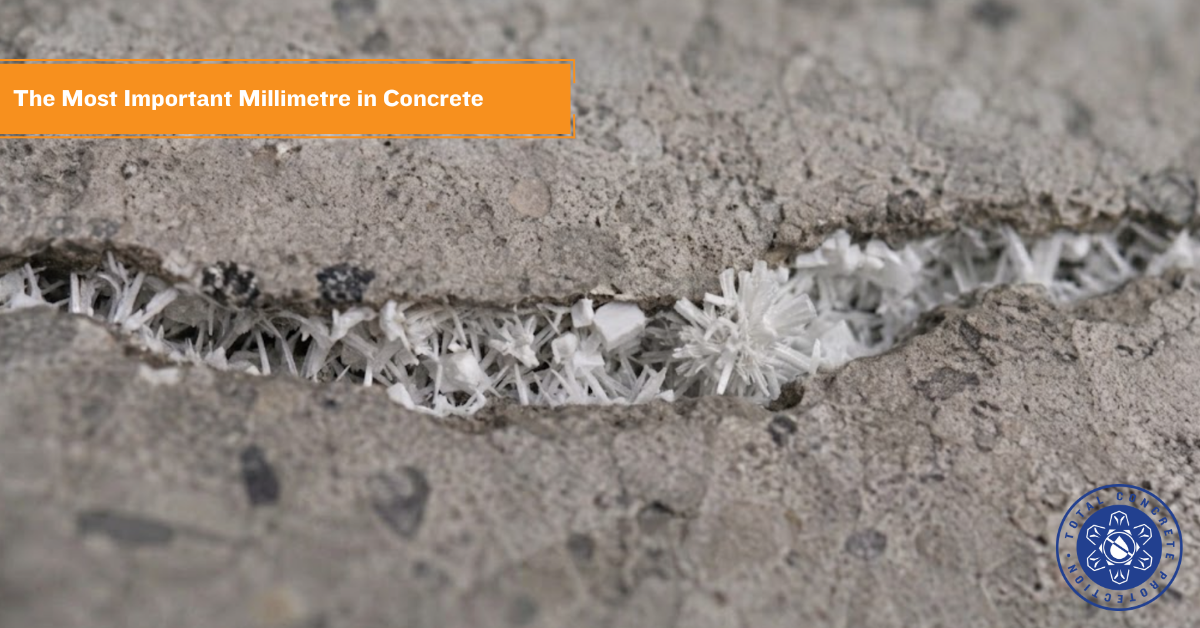
Through cracking, the protective barrier (cover) is effectively and completely bypassed, which is where self-healing mechanisms become particularly important. When water enters a crack, whether carrying aggressive compounds or not, dormant crystalline chemistry becomes activated. Crystalline growth develops within the crack and surrounding matrix, restricting flow paths and reducing water movement. Aggressive compounds encounter increasing resistance as the crystallisation process progresses.
For smaller cracks, complete closure may occur, effectively restoring impermeability and significantly improving durability. For larger cracks, an often-overlooked benefit emerges: although complete closure may not be achieved, even partial crystallisation can provide substantial durability benefits. Every crystal formation creates an obstacle, reduces flow and slows the deterioration process.
The crack may not seal entirely, but its ability to transport water and aggressive compounds is significantly reduced. In effect, the crack becomes throttled.
This distinction is important because flow through a crack does not increase linearly with crack width. Research has shown that increasing a crack width from 0.4 mm to 0.5 mm does not result in a 20% increase in flow simply because the crack is 20% larger. The flow rate effectively doubles. The relationship is exponential rather than linear.
Using the same principle, the difference between a 0.4 mm crack and a 0.8 mm or 1.0 mm crack becomes enormous. While these larger cracks may exceed documented self-healing limits, crystallisation can still significantly reduce their effective transport capacity. A crack initially measuring 0.8 mm may be partially obstructed and effectively behave more like a 0.2 mm or even smaller flow path.
At first glance, this may not sound like a remarkable outcome. The crack remains visible, and complete closure may not have occurred. However, when viewed through the lens of transport mechanisms, the result is profound. Water movement decreases, aggressive compounds encounter resistance, and deterioration slows dramatically. What appears to be a modest reduction in crack width can translate into an exponential reduction in ingress and a substantial increase in service life.
The objective is therefore not simply to seal cracks. The objective is to disrupt transport mechanisms, reduce permeability and restore durability. Every reduction in flow matters, and in the context of long-term service life, even partial crack healing can deliver significant performance benefits. More importantly, if cracking occurs years later, the process repeats. The structure responds, adapts and recovers. In many respects, this aligns closely with modern definitions of resilience. A resilient structure is not one that never experiences damage but one that can respond and adapt to damage.
Designing for Resilience and Sustainability
This way of thinking also opens the door to more rational design. If durability can be improved through lower permeability and enhanced self-healing, then engineers can begin considering more efficient use of materials.
Reinforcement can potentially be placed more rationally within the section. Excessive cover introduced purely for durability concerns can be reconsidered. Fibres can assist with crack control. Crystalline technologies can assist with durability and self-healing.
The result may be less reinforcement, less concrete, lower carbon emissions and longer service life. In an industry increasingly focused on sustainability, this is a powerful concept.
The greenest structure is rarely the one built with the least (or greenest) material … it is the one that lasts the longest.
Doubling service life can effectively halve the embodied carbon associated with replacement, repair and reconstruction activities over time. Ultimately, durability is won or lost at the surface, those first few millimetres that determine whether the structure deteriorates prematurely or achieves its intended design life.
Quality Cover, Not Just Cover
Engineers spend enormous effort understanding exposure conditions and specifying cover. Perhaps the next challenge is ensuring that we understand resistivity and that all cover is quality cover. Because when it comes to durability, the most important millimetre in concrete is the one closest to the surface.
About the Author
Wiljee Blom holds a National Diploma in Civil Engineering, is a Stage 3 Concrete Technologist, and has a postgraduate qualification in Business Management. He serves as Technical Manager at Penetron Africa, where his expertise is in crystalline waterproofing technology and concrete durability solutions.