
By Lexi McKenzie (PMP), BSc Engineering (Civil), Penetron Africa.
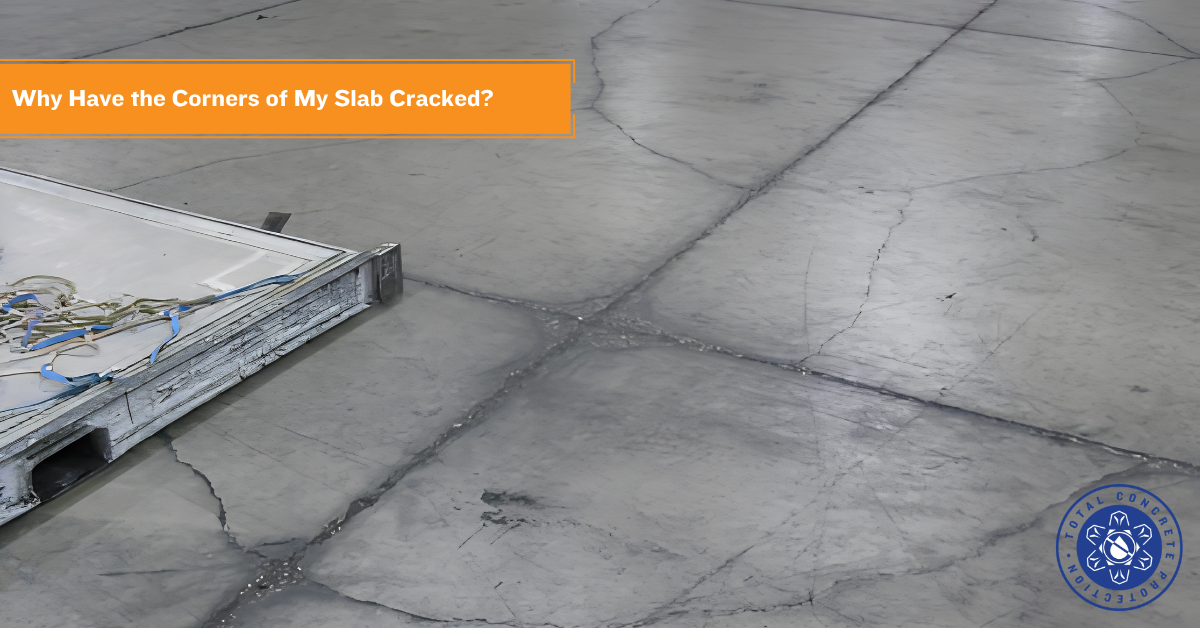
The corners of concrete slabs typically crack due to curling.
Curling happens when a slab dries out unevenly.
The best analogy for this is a slice of bread left on the kitchen counter uncovered for a few hours. When you come back to it, the crust has dried out much more than the middle. If you try to straighten it again, the corners will break off because, as they have dried, they have become more brittle.
On a concrete project, that same exposure starts on site. A slab needs attention during placement, finishing and curing. Decisions made during these stages influence how the concrete develops. By the time a corner has cracked, the opportunity to protect that fresh concrete has already passed.
Uneven Drying and Concrete Slab Curling
The same is true for concrete ground slabs. When concrete is placed on a flat surface, moisture leaves the slab in a non-uniform way. The edges lose moisture faster than the middle, as the water can leave from the top and the sides of the slab. This is compounded in the corners where there are three faces from which water that is needed for hydration leaves the slab.
Curling describes a change in the shape of the slab. Differences in moisture and temperature through its depth cause the top and bottom to change dimensions differently. When the surface dries and shrinks more than the underside, the edges tend to lift. Temperature differences also influence the direction of movement, which is why the diagram shows both upward and downward curling.
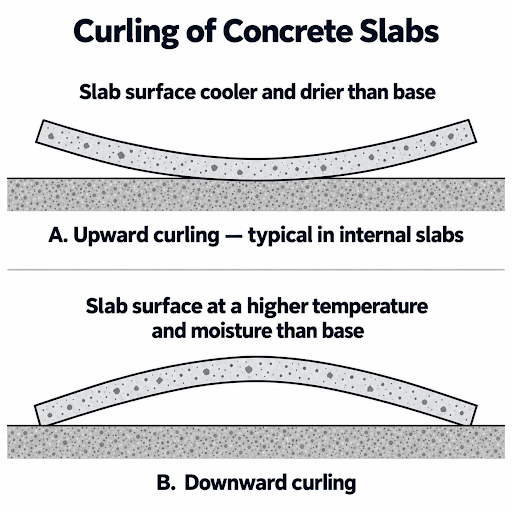
The consequence is a change in support. A curled edge or corner can lose contact with the base beneath it. When traffic loads that unsupported section beyond its capacity, cracking or damage at the joint can follow. In a working industrial floor, understanding the movement and the loading is therefore as important as looking at the visible crack.
Upward curling is often seen in internal floors where the exposed upper surface dries more than the underside. Outside, changing temperatures introduce further movement. This explains why the slab needs to be understood in relation to its environment.
Moisture and Strength Development
If there is no water available for hydration, the concrete will not gain strength the way it is expected to, creating weaker and more brittle concrete in those areas.
Concrete gains strength through hydration: the reaction between cementitious materials and water. Allowing a slab to dry is not what makes it strong. Moisture must remain available while that reaction continues. Curing manages the moisture and temperature conditions needed for the concrete to develop the properties intended by the mix design.
The effects extend beyond strength. Correct curing develops surface hardness and resistance to wear, while inadequate curing leaves the surface more vulnerable to dusting and other defects. This makes curing relevant to the day-to-day performance of a floor, as well as to the condition of its corners.
Good Concrete Practice
There is no substitute for good concrete practices, especially when it comes to mix design, placement, protection and curing of your concrete.
Curling is not a problem that can be avoided by introducing an admixture. Product selection forms part of the specification, but the work on site must deliver the rest. Concrete still needs correct placement, compaction, protection and curing. A specified admixture does not remove these responsibilities or compensate for poor workmanship. The mix, the chosen technology and the construction process must work together.
Weather Conditions and Planning Before the Pour
High air temperature is not the only condition to consider. Wind, low humidity and direct sunlight also increase the rate of moisture loss. These conditions can occur together, and they do not only matter on the hottest days. A dry, windy day still requires attention to evaporation from newly placed concrete.
Planning starts before the concrete arrives. The team needs the people, equipment and materials required to place, finish and protect the slab without avoidable delays. Delivery arrangements and the timing of the work should take the expected conditions into account. Leaving those decisions until concrete is already on the ground makes a demanding operation harder to control.
Curing Ground Slabs
The best way to prevent curling of ground slabs and the subsequent cracks is to use good curing practices. The best way is with sand placed on top of and around the sides of the slab that is then saturated. The sand holds the moisture in longer and is not blown away by wind like hessian or plastic are prone to doing. Sand also provides a protective temperature gradient, minimising the dehydrating effects of high daytime temperatures, especially for structures directly exposed to the sun.
The sequence matters: place the sand first, then wet it until saturated. The sand is not moved into position after it has been wetted. Once the curing method is in place, retaining moisture remains an ongoing task. A layer that is allowed to dry out no longer performs the moisture-retention function intended for it. Clean material and a reliable water supply are practical requirements for maintaining this method.
Curing is also a continuous process. Wetting concrete occasionally and allowing it to dry between applications interrupts the moisture conditions the concrete needs. The responsibility for maintaining the curing method must therefore continue after the placing and finishing teams have completed their work.
Technical Support Throughout the Project
At Penetron Africa, our technical team focuses exclusively on concrete and provides complimentary technical support to our clients throughout all stages of projects, including site support to prevent defects like curling from happening due to oversights.
Having a concrete technologist as part of your project team can reduce the number of defects that require repair, shortening project timelines and reducing unnecessary rework.
That support is most useful when concrete practice is discussed early enough to influence the work. Reviewing the proposed mix, placement arrangements, exposure conditions and curing approach before the pour gives the team an opportunity to resolve practical questions in advance. Good concrete practice needs a clear place in the programme and someone responsible for maintaining it.
Frequently Asked Questions
What Causes Concrete Slab Curling?
Concrete slab curling occurs when a slab dries unevenly. Slab edges lose moisture faster than the middle, with additional moisture loss at corners where three faces are exposed.
Why Does Moisture Loss Affect Concrete Slab Corners?
Concrete requires water for hydration and strength development. When moisture is lost too quickly at the corners, the concrete in those areas becomes weaker and more brittle, increasing its vulnerability to cracking.
Does An Admixture Replace Good Concrete Practice?
No. An admixture does not replace correct mix design, placement, protection and curing. Good concrete practice remains essential when preventing curling and the cracking associated with it.
How Does Wet Sand Support The Curing Of Ground Slabs?
Sand is first placed on top of and around the sides of the slab, then wetted until saturated. It retains moisture for curing and provides temperature protection. Unlike lightweight coverings, the sand is not readily displaced by wind.
Why Include A Concrete Technologist In A Project Team?
A concrete technologist provides specialist input on concrete practice throughout a project. Technical and site support address oversights that lead to defects, repairs and unnecessary rework, with benefits for project timelines.
About the Author
Lexi McKenzie holds a BSc in Civil Engineering and is a qualified Project Management Professional (PMP). She is also a Stage 2 Concrete Technologist. She works with Penetron Africa on concrete infrastructure projects across South Africa, with a focus on durable, practical and technically sound concrete solutions. She is also a member of the Green Building Council South Africa (GBCSA).